Virtual reality used to feel like something out of sci-fi – clunky headsets, limited interactions, and experiences that were cool but often shallow. Fast forward to today, and the game has changed entirely. When artificial intelligence (AI) starts working inside virtual environments, VR stops being static and becomes smart, adaptive, and immersive. Whether you’re training a new workforce, designing products before building them, or exploring worlds created on the fly by AI, these technologies together are redefining what’s possible.
According to market analysts, the generative AI in virtual reality market is expected to grow substantially from about $5.12 billion in 2025 to nearly $15.88 billion by 2029 – an indication that businesses are ready to invest in intelligent VR applications. Research and Markets and even broader estimates suggest the total AI-powered VR market could expand from roughly $21.2 billion in 2023 to an eye-popping $198.5 billion by 2033 at about 25% annual growth.
So let’s talk about what’s going on, how this blend of AI and VR is shaping the future, and why you should care.
What Is AI in Virtual Reality? A Simple Breakdown
When you hear “AI in virtual reality,” think of VR worlds that aren’t looking at your actions and ignoring them – they’re listening, analyzing, adapting, and even learning from what you do. Instead of pre-programmed scenes, the environments respond in real time, just like a coach or teammate would.
AI in VR goes beyond visuals and headset tech – it’s about making the experience live and intelligent. In practical terms, that means smarter interactions, personalized learning, and immersive scenarios that can change based on user behavior.
How AI Enhances Traditional VR Systems
Traditional VR runs predefined scripts – every user follows the same path in the same environment. With AI, these scripts become adaptive rules. AI models can analyze movement, choices, even voice commands to tailor the experience. For example, instead of completing a training module in one rigid way, learners might face different challenges depending on their performance.
Key AI Technologies Powering VR Today
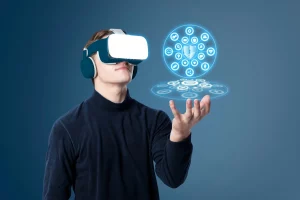
Several AI subfields are powering modern VR:
- Machine Learning (ML): Understands patterns in user actions and behavior.
- Generative AI: Creates backgrounds, characters, and entire virtual worlds dynamically.
- Natural Language Processing (NLP): Lets users speak to AI characters intuitively.
- Computer Vision (CV): Detects and interprets user gestures and movement.
These aren’t just buzzwords – they are the systems making VR responsive rather than static.
Why Businesses Are Rapidly Adopting AI-Driven VR
Companies are investing in virtual reality in AI because it delivers measurable value. Intelligent VR can cut down training time, reduce errors, and provide analytics that traditional video lessons or classroom sessions simply can’t match. And with generative tools removing manual content creation bottlenecks, producing high-quality VR experiences is becoming faster and more affordable.
The Market Landscape: How Big Is AI in Virtual Reality?
AI-powered VR is not a fringe experiment – it’s becoming a major technology trend.
The broader virtual reality market was valued at over $16.3 billion in 2024 and is projected to reach more than $123 billion by 2032, growing at nearly 29% annually across sectors like gaming, healthcare, automotive, and enterprise.
Within that larger trend, generative AI in virtual reality – specifically where AI generates scenes, behaviors, and content – is gaining rapid momentum. Reports estimate this sub-sector alone at $5.12 billion in 2025, growing strongly through the end of the decade.
Global Market Growth and Forecasts
This projected growth reflects rising investments and interest across industries, not just entertainment. From training simulations to healthcare planning, enterprises are willing to pay for AI insights fused into VR experiences.
Industries Fueling Market Expansion
Some of the fastest adopters include:
- Healthcare: For simulation and surgical training.
- Education & Corporate Training: Personalized immersive learning.
- Manufacturing & Design: Prototyping and automation training.
- Retail & Marketing: Virtual showrooms and shopping experiences.
Key Drivers and Challenges in AI-VR Adoption
- Drivers: Improved hardware performance, better AI models, and falling headset prices.
- Challenges: Computational costs, data privacy concerns, and ensuring unbiased AI behavior.
How AI Is Transforming VR Experiences Across Industries
The combined power of AI and VR is letting firms do things that were impractical or impossible just a few years ago.
Enterprise Training & Skill Development
In the enterprise world, training needs vary from safety drills to soft skills like leadership. Intelligent virtual environments adapt in real time, giving learners scenarios tailored to their strengths and weaknesses.
For example, VR simulation training allows workers to practice complex tasks repeatedly without risk – whether it’s heavy machinery operation or customer service role plays – and AI can adjust difficulty on the fly.
AI-Powered VR for Enterprise Upskilling
AI doesn’t just run the environment – it also analyzes performance. By tracking actions and reactions, companies gain insights into strengths, gaps, and progression patterns that weren’t visible before.
Generative AI in Virtual Reality Training
Traditional VR requires developers to build every scene manually. With generative AI in virtual reality training, models can generate environments, dialogues, and even scenario variations instantly. This makes personalized training more affordable and flexible across industries like aviation, healthcare, or emergency services.
Generative AI in Virtual Reality: A New Era of Immersive Intelligence
Generative AI is rewiring how VR experiences are created and consumed. Rather than relying on static assets, environments evolve as users interact with them.
What Generative AI Brings to VR Worlds
Generative models can create landscapes, characters, and storylines that react to user behavior. These dynamic worlds increase engagement and create unique experiences every time someone enters the virtual realm.
Use Cases of Generative AI in VR
Across training, education, and simulation, generative tools reduce production time and let teams spin up tailored modules in minutes rather than weeks.
Real-World Examples of Generative AI-Powered VR
Research and pilot projects show that generative AI is already creating personalized learning paths and adaptive worlds – for instance, in cultural training or specialized skill drills where every trainee gets a uniquely tailored field experience.
AI-Driven VR for Corporate Learning and Development
Businesses are finding that AI-enhanced VR isn’t just “cool tech” – it drives real outcomes.
Personalized Learning Experiences
AI models analyze how users interact with environments. Based on this performance data, the VR system adjusts difficulty, offers targeted feedback, and keeps learners engaged longer than traditional modules.
Real-Time Coaching and Feedback
AI doesn’t wait until the end of a session – it can guide learners in real time, offering hints, corrections, and next steps as the scenario unfolds.
Measuring Learning Outcomes With AI
With AI, organizations get dashboards filled with performance metrics – showing improvements, time to competency, and areas for refinement. This data helps L&D leaders justify investment and improve program design.
VR for Training: How AI Makes Immersive Learning Smarter
This section focuses on why AI-enabled training is outperforming traditional approaches.
Why AI-VR Training Outperforms Traditional Methods
Empirical studies show that immersive VR training environments significantly improve learning outcomes compared with passive methods like video or slides. VR allows learners to experience situations rather than just observe them.
How AI Reduces VR Training Cost and Development Time
AI tools can generate reusable assets and scenarios, meaning less manual coding and design time, lower overheads, and quicker iteration cycles.
Examples of AI-Enabled VR in High-Risk Industries
In sectors like manufacturing and construction, AI-VR drills help workers practice hazardous procedures safely and efficiently – significantly reducing on-the-job incidents.
AI + VR for Product Design, Prototyping & Simulation
AI isn’t just for training – it’s also fueling design and testing workflows.
Predictive Design With AI-VR
Designers can prototype multiple iterations in VR before building physical versions. AI predicts stress points, ergonomics issues, and user interaction patterns before a real prototype is ever made.
Real-Time Simulation & Error Detection
AI models simulate real-world physics and user behavior within VR. This helps teams find design flaws faster and improve product quality.
Integrating AI-VR Into Existing Product Pipelines
Modular AI-VR systems link into product lifecycle tools, making workflows smoother across ideation, testing, and deployment.
Real-World Use Cases: How Companies Are Leveraging AI-VR Today
Applications of virtual reality in AI are diverse and growing.
AI-Enhanced VR in Healthcare
VR patients can practice surgical procedures in realistic scenarios, while AI tracks precision and methodology. Studies also suggest emotive avatars can increase empathy and engagement
AI-VR in Manufacturing & Automation
AI tools simulate assembly lines and help employees perfect operational procedures before real-world deployment.
AI-Driven VR in Education
VR classrooms are expanding, using adaptive AI feedback to personalize academic experiences.
Retail & Customer Experience With VR + AI
From virtual try-ons to personalized shopping worlds, AI-powered VR is turning browsing into tailored experiences.
Challenges, Risks & Ethical Concerns of AI in VR
As powerful as these technologies are, developers and organizations must navigate challenges carefully.
Privacy & Data Usage
Immersive systems track body movement, gaze, and behavioral signals. Ensuring ethical data usage and consent frameworks is essential.
Bias in AI-Generated VR Scenarios
AI models trained on skewed data can reinforce bias. Diverse datasets and continuous testing are necessary safeguards.
Hardware Limitations & Cost Barriers
High-fidelity simulations require powerful hardware. While headsets are becoming cheaper, computational demands for AI-VR remain significant.
Ensuring Transparency & Safety in AI-VR Systems
Explainability and human oversight are critical – especially where training outcomes affect real-world safety.
Future of AI in Virtual Reality: What’s Coming Next?
Looking ahead, we see a world where AI personalizes VR experiences like never before.

Hyper-Personalized VR Worlds
Future systems will adapt environments in real time based on personality, learning pace, and performance feedback.
Autonomous Virtual Humans & NPCs
Imagine virtual characters that reason, teach, and interact naturally – not just follow scripts.
AI-Generated Worlds for Instant Training Scenarios
Teams could spin up tailored training worlds in minutes based on specific job tasks.
How AI Will Shape Workplace Training by 2030
Industry analysts anticipate intelligent VR as a standard part of enterprise training, with AI generating analytics, feedback, and adaptive content as baseline features.
Conclusion: The Intelligent Future of VR Is Already Here
There’s no doubt that AI in virtual reality has moved from conceptual to practical, driving smarter, more immersive, and highly adaptable experiences. Whether you’re in business, education, healthcare, or product design, intelligent VR solutions are unlocking new ways to learn, test, and create.
For organizations seeking practical deployment – from enterprise training to creative simulations – platforms like Juego neXR are emerging as partners who build research-backed immersive experiences that help teams perform better and learn faster without compromising safety or quality.
FAQs on AI in Virtual Reality
Yes. AI enhances virtual environments by creating adaptive content, recognizing user behavior, and driving real-time responses to interactions.
Generative AI builds virtual scenes, dialogue, and dynamic content on demand – enabling truly personalized and evolving experiences.
AI adapts difficulty, offers real-time feedback, and generates scenario variations – making training more effective than traditional methods.
Healthcare, manufacturing, education, and enterprise training are among the top adopters because of measurable performance benefits.
Challenges include data privacy, computational costs, and bias in AI behavior models.
Over time, AI can lower costs by automating content creation and reducing manual design work.
Not entirely. AI augments instructors by providing data insights and adaptive experiences, but human expertise remains irreplaceable.
Revolutionize the future of business with Juego neXR
Table of Contents
- What Is AI in Virtual Reality? A Simple Breakdown
- The Market Landscape: How Big Is AI in Virtual Reality?
- How AI Is Transforming VR Experiences Across Industries
- Generative AI in Virtual Reality: A New Era of Immersive Intelligence
- AI-Driven VR for Corporate Learning and Development
- VR for Training: How AI Makes Immersive Learning Smarter
- AI + VR for Product Design, Prototyping & Simulation
- Real-World Use Cases: How Companies Are Leveraging AI-VR Today
- Challenges, Risks & Ethical Concerns of AI in VR
- Future of AI in Virtual Reality: What’s Coming Next?
- Conclusion: The Intelligent Future of VR Is Already Here
- FAQs on AI in Virtual Reality
Related Posts
Companies Using VR for Training: Leading Brands and Real-World Use Cases
Posted on February 18, 2026

Virtual Reality Future Trends in 2026: How VR Is Evolving Across Industries
Posted on January 20, 2026
Virtual Reality Features and Functions: A Complete Guide
Posted on January 13, 2026




Our Offices

India
Bangalore
GR Grand Plaza, 2nd Floor, JP Nagar, 6th Phase, Bangalore – 560 078



KSA
Jeddah
St Idris Square, 4036 Helmi Koutbi, Al Zahra, Jeddah 23425, Saudi Arabia
Follow Us On:


© 2026 Juego neXR. All Rights Reserved.