Every major technology shift follows the same pattern: curiosity, skepticism, experimentation, and finally—necessity. Virtual Reality has reached that final stage. In 2026, VR is no longer a “nice-to-have” innovation. It is becoming an operational standard in training, healthcare, manufacturing, and enterprise collaboration.
Gaming enthusiasts no longer dominate the VR landscape—Fortune 500 companies do. With 175+ million active users worldwide and three-quarters of major corporations deploying VR solutions, we’re witnessing a fundamental shift from experimentation to execution.
The question isn’t whether VR will transform your industry anymore. It’s whether you’ll adapt before your competitors do.
This blog explores the current and latest virtual reality trends, adoption data, industry applications, and strategic insights to capitalize on VR’s transformation from experimental technology to an operational necessity. The question isn’t whether VR will transform your industry anymore—it’s whether you’ll adapt before your competitors do.
VR Popularity and Adoption in 2026: The Data Behind the Growth
The data reveals an industry reaching critical mass, with user adoption and market growth accelerating across all major regions and sectors.
Market Growth Reaches Critical Mass
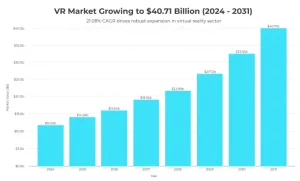
The global virtual reality market is expected to reach USD 15.64 billion in 2026, with projections showing growth to USD 40.71 billion by 2031. That’s a compound annual growth rate of 21.08%.
Some analysts predict even more aggressive expansion, with the market potentially reaching USD 123.06 billion by 2032. These aren’t speculative forecasts—they’re backed by current adoption patterns and enterprise deployment data.
User Base Expansion
Market revenue only tells half the story. User adoption reveals the real transformation.
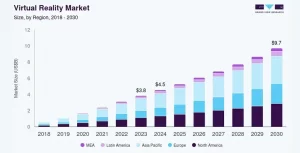
171 million people worldwide actively used virtual reality in 2024 across gaming, professional, and educational applications. By the end of 2025, this figure jumped to 216 million users—a 26% year-over-year surge.
The United States mirrors this upward trend. VR users grew from 77 million in 2024 to 80.6 million in 2025, with projections pointing to 91.3 million users by 2028. This steady climb highlights how VR is becoming part of routine workflows, not just occasional use cases.
Hardware Shipments Signal Industry Momentum
Spatial computing devices—including advanced VR headsets like the Apple Vision Pro—could drive XR hardware shipments to 40 million units annually by 2026. This volume reflects production scaling and ecosystem maturation previously unseen in this technology category.
Unlike earlier cycles where hardware launches outpaced real-world applications, today’s growth is demand-led. Enterprises are standardizing VR headsets across locations, updating content centrally, and integrating immersive tools into daily operations. This alignment between hardware readiness and practical deployment marks a turning point in the VR industry, where VR is no longer limited by infrastructure but enabled by it.
Key Virtual Reality Trends Reshaping 2026
Five transformative trends are converging to make VR indispensable across industries, from AI-powered personalization to accessible web-based experiences.
1. AI Integration and Spatial Computing: The Intelligence Revolution
Virtual reality trends in 2026 center on intelligence, not just visuals. The convergence of Physical AI and spatial computing creates what industry experts call “VR+”—a next-generation blending of AR, MR, and intelligent automation.
Generative AI models now create personalized, adaptive VR environments in real-time. Instead of static pre-rendered scenes, AI agents understand your surroundings, preferences, and behavior, then dynamically generate worlds tailored to your needs.
Real-World AI-Powered VR Applications:
- Customer Service: AI avatars provide 24/7 immersive support, adapting responses based on customer sentiment and interaction history
- Healthcare Training: AI tutors learn from trainee performance and dynamically generate targeted practice scenarios for struggling techniques
- Manufacturing: AI-enhanced simulations predict bottlenecks and test optimizations before implementation (BMW reduced planning costs by 30%)
- Gaming: Game worlds adapt in real-time, generating unique quest lines and challenges customized to individual play styles
2. Photorealism: When Virtual Becomes Indistinguishable From Real
Photorealistic VR environments have become the industry standard in 2026, particularly in enterprise applications where realism directly impacts learning outcomes. The Quest 4 and competing next-generation headsets feature higher resolution displays and advanced eye tracking, enabling foveated rendering that maintains visual fidelity while reducing processing load.
Volumetric video technology captures real humans and environments as 3D digital assets, allowing realistic interaction and spatial presence. These virtual reality training solutions deliver experiences nearly indistinguishable from reality.
Industry Applications of Photorealism:
| Industry | Application | Business Impact |
| Luxury Retail | Virtual product inspection (leather grain, material texture) | Reduced sales cycles and return rates |
| Healthcare | Photorealistic surgical simulations | 23% faster operations, 6% fewer errors |
| Real Estate | Property tours with accurate lighting at different times of day | Faster sales, fewer physical visits |
| Manufacturing | Digital twin equipment for maintenance training | Zero equipment downtime for training |
3. Haptic Technology Goes Mainstream: Touch Enters the Digital World
Haptic feedback has moved from specialized research labs into consumer-grade hardware. Haptic gloves and suits now cost under USD 500, making full-body touch feedback accessible to businesses and prosumers.
5G connectivity enables real-time haptic streaming with minimal latency, critical for synchronized touch feedback across global collaborations. Cloud-rendered haptics mean you don’t need specialized hardware at every location—lightweight gloves receive feedback signals transmitted over 5G networks.
New ultrasonic haptics create mid-air touch sensations without physical contact, opening the door to contactless interaction in healthcare and clean environments. These innovations represent the powerful features of virtual reality technology advancing beyond visual immersion.
Haptic Technology Use Cases:
- E-commerce: Customers feel leather texture, jewelry weight, and fabric grain before purchase (IKEA saw a 7.7x dwell time increase)
- Remote Surgery: Surgeons feel tissue resistance and instrument feedback during remote operations
- Manufacturing: Workers receive immediate haptic alerts when parts misalign or incorrect force is applied
- Luxury Branding: Customers literally feel product quality during immersive brand experiences
4. 5G Connectivity Unleashes Cloud-Rendered VR
The rollout of 5G networks eliminates traditional barriers of wired VR systems, enabling truly mobile and collaborative training experiences. Cloud-rendered VR removes the requirement for expensive, powerful computing hardware at every location.
5G enables edge computing—processing happens nearby in the network rather than locally or remotely—delivering responsiveness comparable to local rendering while freeing users from tethering to equipment. This infrastructure breakthrough makes VR simulation training accessible at an unprecedented scale.
5G-Enabled VR Scenarios:
- Multi-Site Corporate Training: Train 10,000 workers across 30 global facilities using lightweight headsets with centrally-updated cloud content
- Real-Time Collaborative Design: Engineers in Munich and California modify the same 3D vehicle model simultaneously
- Emergency Response Training: Firefighters across regions participate in synchronized disaster simulations with dynamic scenarios
- Instant Global Updates: Safety protocol changes implemented globally in minutes instead of weeks
5. WebXR and Social Shareability: VR Beyond the Headset
VR experiences in 2026 aren’t exclusive to expensive headsets and specialized hardware. WebXR standards enable immersive content to run in web browsers and on standard smartphones, making VR experiences as shareable as social media posts.
WebXR allows developers to build immersive experiences that work across devices—from high-end VR headsets to smartphones to AR glasses. Users access the same VR experience on whatever device they own, massively expanding the addressable audience.
This accessibility transforms how organizations deploy VR learning solutions, removing hardware barriers that previously limited adoption. Companies report 1200% higher share rates on social platforms for immersive ads compared to traditional 2D content.
WebXR Impact Across Sectors:
- Marketing: Immersive brand experiences accessible through smartphone AR drive viral engagement
- Education: Students worldwide access photorealistic 3D anatomy lessons through web browsers regardless of device ownership
- Enterprise Training: Employees train on mobile devices, laptops, or VR headsets with identical learning outcomes
- Social Events: Users attend virtual concerts and conferences without specialized hardware
You Can Also Check Out: Leading Companies that Use VR for Training Programs
Industry Evolution: How Businesses Are Using Virtual Reality
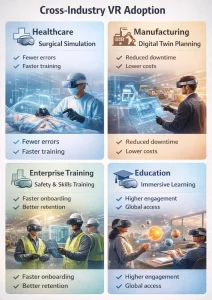
From healthcare to manufacturing, businesses are deploying VR to solve specific operational challenges, train employees faster, and create customer experiences impossible through traditional channels.
-
Healthcare: From Training to Surgical Precision
Healthcare experiences the highest growth rate (32.2% CAGR) among all VR-adopting industries. Over 75% of Fortune 500 companies already use VR for training, and in healthcare, the applications save lives.
Surgeons practice complex procedures in photorealistic operating environments. One hospital system reported that surgeons who practiced a procedure in VR performed the actual operation 23% faster and with 6% fewer errors than surgeons without VR training.
The market for VR healthcare applications is projected to reach USD 11.3 billion by 2030. This growth demonstrates the clear benefits of VR training in medical settings where precision directly impacts patient outcomes.
Current Healthcare VR Implementations:
-
- Surgical Simulation: Practice complex procedures in risk-free photorealistic operating rooms
- Anatomy Education: Explore 3D human anatomy from every angle, impossible with textbooks or cadavers
- Emergency Response: Paramedics practice cardiac arrests and trauma scenarios with immediate feedback
- Remote Diagnostics: Specialists examine patients through immersive VR environments with 3D diagnostic imaging
-
Enterprise Training: The Fortune 500 Standard
The VR training market is expected to reach USD 298 billion by 2033, with enterprise users accounting for more than half of total VR revenue by 2030. This massive market reflects how fundamentally VR training vs traditional training has shifted corporate learning strategies.
Oil rig operators train in VR simulations that replicate dangerous machinery, chemical processes, and emergency scenarios. Amazon invested in HTC VR headsets for training distribution center managers, seeing measurable improvements in employee retention and customer satisfaction scores.
Industrial equipment manufacturers created VR forklift simulators that train operators without equipment downtime. Companies report significant cost savings by training teams safely and efficiently while reducing equipment wear.
Measurable Enterprise VR Training Results:
| Metric | Performance Improvement |
| Program Completion Speed | 75.26% report faster completion |
| Training Scalability | 78.86% successfully scaled to other departments |
| ROI (Finance Sector) | 92% report positive ROI through increased productivity |
| Skill Retention | 80% retention vs 20% with traditional methods |
| Training Time Reduction | 40% faster than classroom instruction |
Understanding VR training cost helps organizations justify these investments through measurable ROI. Most successful enterprises see VR ROI within 12-24 months through reduced training time, improved safety, and faster employee productivity.
-
Manufacturing & Design: Virtual Prototyping Cuts Costs
Manufacturing discovers that creating products in VR before building physical prototypes saves money and accelerates innovation. This approach eliminates expensive prototype iterations and enables global teams to collaborate without physical travel.
BMW deploys Nvidia Omniverse to plan factory layouts, test robot placements, and simulate workflow changes. This virtual planning approach reduced factory planning costs by 30% and accelerated new model launches across 30+ sites.
Major carmakers use custom virtual reality solutions to visualize and test vehicle designs, examining how components fit, function under stress, and work aesthetically from multiple angles. Modifications made in VR avoid costly physical prototype revisions.
Manufacturing VR Applications:
-
- Factory Layout Optimization: Test robot placements and workflow changes before physical implementation
- Automotive Design Review: Global teams collaborate on vehicle designs without international travel
- Architectural Visualization: Explore structures at 1:1 scale before construction to catch spatial planning issues
- Equipment Training: Create digital twins where technicians master maintenance before touching actual machinery
-
Retail & E-commerce: Immersive Shopping Experiences
Retail adopts VR to overcome the fundamental limitation of online shopping: customers can’t see, touch, or feel products. Immersive experiences bridge this gap while providing engagement metrics impossible in physical stores.
Retailers use AR/VR to let customers see how clothing fits their bodies, how eyeglasses look on their faces, or how makeup shades complement their skin tones. Bold Metrics uses VR to create “virtual body maps,” allowing customers to virtually try on clothing in 3D.
Real estate agents conduct full immersive property tours where buyers explore homes remotely before deciding to visit in person. This dramatically narrows the pool of properties requiring physical visits and accelerates sales cycles.
Retail VR Success Stories:
-
- Virtual Fitting Rooms: AR/VR shows how clothing fits, how eyeglasses look, how makeup complements skin tone
- Real Estate Tours: Buyers explore properties remotely before physical visits, accelerating sales cycles
- Automotive Showrooms: Customers configure vehicles with different colors and features before purchase
- Furniture Visualization: IKEA’s AR app demonstrates increased engagement and higher purchase intent
-
Education & Professional Development: Scalable Learning
Students engage with complex concepts through spatial visualization impossible in traditional classrooms. A biology student can shrink to the size of a molecule and navigate through cells; a history student can walk through ancient Rome and interact with historical scenarios.
Microsoft Mesh and similar platforms create virtual workspaces where remote employees experience company culture, meet colleagues, and learn processes in shared immersive environments rather than watching training videos. This represents the successful implementation of VR training at the enterprise level.
Trade schools use VR to teach welding, electrical installation, plumbing, and HVAC in safe, failure-tolerant environments where mistakes provide learning without material waste. These applications demonstrate the transformative power of VR learning solutions in vocational education.
Educational VR Deployments:
- Interactive Learning: Students engage with complex concepts through spatial visualization and interaction
- Employee Onboarding: Virtual workspaces create culture immersion for remote employees
- Vocational Training: Trade skills taught in safe, failure-tolerant environments without material waste
- Global Access: Students worldwide have access to identical educational experiences regardless of physical location
How to Capitalize on VR Trends in 2026
Strategic VR adoption requires clear use cases, phased implementation, and infrastructure investment beyond hardware—but organizations that execute well see ROI within 24 months.
For Enterprise Leaders: Strategic Investment Priorities
Start with high-impact use cases. Focus VR investments on areas with clear ROI: employee training, customer experience, product design, or operational optimization.
Avoid building immersive experiences just because the technology exists. The most successful implementations solve specific business problems with measurable outcomes.
VR Investment Framework:
- Pilot Then Scale: Begin with one department or location, document cost savings and learning improvements
- Invest in Infrastructure: VR success requires 5G connectivity, cloud rendering, content libraries, and trained staff (hardware is only 30%)
- Prioritize Employee Experience: VR training that reduces time-to-productivity becomes a talent retention tool
- Measure Everything: Track completion rates, retention, safety incidents, and time-to-competency
- Plan for 12-24 Month ROI: Most successful enterprises see positive returns within two years
Successful vr training implementation demands this holistic approach, considering infrastructure and content as equally important to hardware.
For Content Creators and Developer Teams
Use generative AI tools to accelerate 3D asset creation, environmental design, and character animation. This dramatically reduces development costs and timelines while enabling rapid iteration.
Create content that works across multiple platforms—VR headsets, AR glasses, smartphones, web browsers. Use WebXR standards to maximize reach and ensure your content remains accessible as new devices emerge.
Developer Success Strategies:
- Build for Accessibility: Deploy virtual reality training solutions that work across VR headsets, smartphones, and web browsers
- Solve Real Problems: Focus on specific business challenges (training, design, collaboration) rather than entertainment novelty
- Add Social Features: Experiences facilitating collaboration see higher engagement and longer retention
- Use AI Acceleration: Leverage generative AI for faster asset creation and reduced development costs
For Investors and Venture Capital
Rather than betting on generalist VR companies, invest in teams solving specific vertical problems (healthcare training, manufacturing, retail). Specialization commands higher valuations and achieves faster profitability.
Companies building the underlying infrastructure—haptic technology, 5G-enabled streaming, cloud rendering platforms, spatial operating systems—often have longer runways and larger TAM than content-focused startups. These infrastructure plays benefit from every VR application built on top of them.
Investment Focus Areas:
- Vertical Specialists: Companies solving healthcare, manufacturing, or retail-specific problems
- Infrastructure Plays: Haptic technology, cloud rendering, 5G streaming platforms
- AI Integration: Startups combining spatial computing with generative AI
- Enterprise SaaS: Platforms enabling businesses to deploy custom virtual reality solutions without technical expertise
Future Trends to Look Out for in VR
The next five years will see VR transition from a specialized tool to a ubiquitous infrastructure, embedded into daily operations for millions of knowledge workers worldwide.
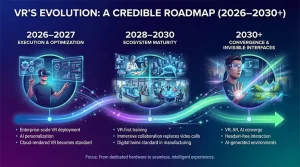
2026-2027: Execution and Enterprise Dominance
By late 2026, over 50% of Fortune 500 companies will have deployed VR for employee training or customer engagement. The focus shifts from “is VR viable?” to “how do we optimize VR for our specific workflows?”
Photorealism becomes the baseline expectation. AI-driven personalization drives engagement and ROI.
Near-Term Milestones:
- Photorealism becomes the baseline expectation across all applications
- AI-driven personalization drives measurable engagement and ROI improvements
- 5G enables cloud-rendered VR across global enterprises
- Haptic feedback becomes standard in specialized applications
- WebXR accessibility expands consumer VR to billions of smartphone users
2028-2030: Ecosystem Maturity and Integration
VR becomes embedded into daily operations for millions of knowledge workers. Just as email and video conferencing became invisible necessities of business, VR-based training and collaboration will be standard practice.
Remote work will be conducted primarily through immersive VR collaboration spaces. Medical training will predominantly occur in VR before practical observation.
2028-2030 Predictions:
- Remote work is conducted primarily through immersive VR collaboration spaces
- Medical training predominantly in VR before practical observation
- Manufacturing operations run partially through VR oversight and simulation
- Healthcare diagnostics leverage immersive 3D visualization
- Consumer VR penetration reaches 30-40% globally through WebXR accessibility
2030+: Convergence and Interface Evolution
The line between VR, AR, and physical reality becomes intentionally blurred. Brain-computer interfaces developed by companies like Neuralink may enable VR experiences without headsets.
Holographic presentations could replace slides and video conferencing. Interfaces potentially become invisible through BCIs, while AI-generated worlds become indistinguishable from reality.
Conclusion
Virtual Reality has crossed from innovation curiosity to operational infrastructure. With 215+ million global users, a USD 15.64 billion market growing at 21% annually, and enterprise adoption now standard among Fortune 500 companies, VR is no longer optional—it’s becoming essential.
The convergence of AI, 5G connectivity, photorealism, haptics, and WebXR accessibility creates an inflection point where organizations must act or fall behind. Companies like Juego neXR are building the infrastructure and content platforms that make enterprise VR deployment accessible, scalable, and measurable—transforming how businesses train, design, and engage customers.
Organizations that strategically adopt VR for training, collaboration, and customer engagement will see measurable ROI within 24 months. The era of VR experimentation has ended. The era of VR execution has begun.
Frequently Asked Questions
The top VR trends include AI-powered personalization creating adaptive environments, photorealistic graphics becoming industry standard, affordable haptic technology enabling touch feedback, 5G-powered cloud rendering eliminating hardware constraints, and WebXR making VR accessible through web browsers and smartphones.
The global VR market reached $15.64 billion in 2026 and is projected to grow to $40.71 billion by 2031, representing a 21.08% compound annual growth rate. More aggressive projections suggest the market could reach $123.06 billion by 2032.
Healthcare leads with 32.2% CAGR, followed by enterprise training (expected to reach $298 billion by 2033), manufacturing (30% cost reduction in factory planning), retail (1200% higher social engagement), and education. VR in healthcare applications is particularly transformative for surgical training and diagnostics.
Most enterprises see ROI within 12-24 months. Measurable benefits include 75% faster program completion, 40% reduced training time, 80% higher skill retention than with traditional methods, and 92% of finance companies reporting positive ROI through increased productivity and efficiency.
Revolutionize the future of business with Juego neXR
Related Posts
Companies Using VR for Training: Leading Brands and Real-World Use Cases
Posted on February 18, 2026

Virtual Reality Future Trends in 2026: How VR Is Evolving Across Industries
Posted on January 20, 2026
Virtual Reality Features and Functions: A Complete Guide
Posted on January 13, 2026




Our Offices

India
Bangalore
GR Grand Plaza, 2nd Floor, JP Nagar, 6th Phase, Bangalore – 560 078



KSA
Jeddah
St Idris Square, 4036 Helmi Koutbi, Al Zahra, Jeddah 23425, Saudi Arabia
Follow Us On:


© 2026 Juego neXR. All Rights Reserved.