Virtual reality is no longer a “wait and watch” technology. It has quietly moved from experimental labs and gaming rigs into factories, hospitals, training rooms, and corporate learning programs. What’s interesting is that most people still talk about VR as if it’s just a headset. In reality, the real value lies in the virtual reality features and functions working together behind the scenes.
From immersive environments and motion tracking to AI-driven simulations and analytics, VR today is a full-fledged technology ecosystem. This guide breaks down those capabilities in a way that’s practical, up-to-date, and grounded in how VR is actually being used. If you’re trying to understand what VR can really do-and why organizations are investing in it-this guide covers it all.
What Is Virtual Reality and How Do Its Features Actually Work?
Virtual reality is best understood not as a single product, but as a system where hardware, software, and interaction models come together to create believable digital experiences.
Virtual Reality Explained Beyond Headsets
At its core, virtual reality is a computer-generated environment designed to simulate real or imagined worlds while responding to a user’s movements in real time. Unlike traditional screens, VR places the user inside the experience. The sense of presence comes from synchronizing visuals, motion, and interaction so the brain accepts the virtual world as real.
This is where the features of virtual reality technology matter. Without precise tracking, fast rendering, and spatial audio, VR quickly feels artificial. When these elements align, users don’t just see a simulation-they experience it.
Core Components Powering Virtual Reality Systems
Every VR system relies on a few foundational components. Hardware like head-mounted displays, sensors, and controllers capture user movement. Software engines render 3D environments and manage physics, lighting, and interactions. On top of that, networking and data layers allow real-time collaboration, content updates, and analytics.
Together, these components enable modern virtual reality features that go far beyond simple visualization.
Key Features of Virtual Reality That Enable Immersive Experiences
The strength of VR doesn’t come from one standout capability. It comes from multiple features working simultaneously to create realism, responsiveness, and immersion.
Immersive 3D Environments and Spatial Presence
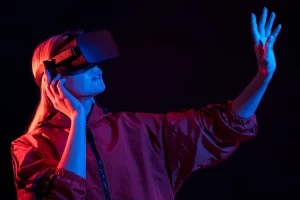
One of the most recognizable key features of virtual reality is its ability to create fully immersive 3D environments. These spaces are rendered in real time, allowing users to move naturally and perceive depth just as they would in the physical world. Spatial presence-the feeling of “being there”-is what separates VR from videos or 3D walkthroughs.
Motion Tracking and Real-World Interaction Mapping
Modern VR systems track head movement, hand gestures, and in some cases full-body motion. This allows digital environments to respond instantly to physical actions. Inside-out tracking, now common in standalone headsets, removes the need for external sensors while maintaining accuracy. This responsiveness is essential to core VR features that feel intuitive rather than mechanical.
Stereoscopic Vision and Wide Field of View
VR headsets present slightly different images to each eye, mimicking human binocular vision. Combined with a wide field of view, this creates realistic depth perception. When done well, this visual fidelity strengthens immersion and reduces the mental effort needed to interpret the environment-an important factor in professional training scenarios.
Low-Latency Systems and Real-Time Responsiveness
Latency is often invisible when it’s low and immediately noticeable when it’s not. VR systems aim for motion-to-photon latency below 20 milliseconds to prevent discomfort. Low latency ensures that visual updates match physical movement, making these features of VR comfortable and usable for extended sessions.
Functional Capabilities That Define Virtual Reality Applications
Features describe what VR has. Functions describe what VR enables people to do. This distinction matters when evaluating VR for real-world use.
Real-Time Simulation and Scenario Replication
One of the most powerful virtual reality features and functions is the ability to simulate real-world scenarios safely and repeatedly. From operating heavy machinery to handling emergency situations, VR allows users to practice without real-world risk. These simulations can be paused, replayed, and adjusted-something physical environments can’t offer.
Multi-User Collaboration in Virtual Spaces
VR is no longer a solo experience. Multi-user environments allow teams to collaborate inside shared virtual spaces. Avatars, spatial voice chat, and synchronized interactions make remote collaboration feel more natural than video calls. This functionality is increasingly used for design reviews, training sessions, and operational planning.
Data Capture, Performance Tracking, and Analytics
Unlike traditional training methods, VR captures granular performance data. Every movement, decision, and reaction can be recorded and analyzed. This data helps organizations assess skill gaps, track progress, and improve training outcomes over time.
Advanced VR Features Transforming Enterprise and Training Use Cases
As VR matures, advanced technologies are extending its capabilities far beyond static simulations.
Artificial Intelligence Enhancing VR Experiences
AI is becoming deeply embedded in immersive systems, enabling adaptive environments that respond to user behavior. Through AI in virtual reality, simulations can adjust difficulty levels, generate realistic non-player characters, and provide real-time feedback. This makes training more personalized and effective, especially for complex skill development.
Haptic Feedback and Sensory Augmentation
Haptic devices introduce touch into virtual environments. Gloves, vests, and controllers simulate texture, resistance, and vibration. While still evolving, haptics significantly enhance realism in technical training, medical simulation, and equipment handling.
Eye Tracking and Cognitive Response Analysis
Eye-tracking technology reveals where users focus their attention and how they process information. In training contexts, this data can identify hesitation, confidence levels, and situational awareness. These insights are particularly valuable in safety-critical industries.
Features of Virtual Reality in Training and Learning Environments
Training is one of the fastest-growing applications of VR, largely because its features align closely with how people learn best.
Skill Transfer, Retention, and Experiential Learning
VR enables learning by doing. Studies show that immersive learning improves retention and confidence compared to passive methods. According to PwC, VR learners completed training up to four times faster than classroom learners and were significantly more emotionally connected to the content-clear benefits of VR training that traditional methods struggle to match.
Virtual Reality vs Traditional Learning Systems
When comparing VR training vs traditional training, differences emerge quickly. VR offers consistent experiences, reduced risk, and scalable delivery across locations. While upfront investment exists, long-term cost savings often come from reduced travel, fewer physical resources, and faster onboarding.
Implementation and Deployment Capabilities
Successful VR adoption depends on thoughtful VR Training Implementation. This includes hardware selection, content customization, user onboarding, and integration with learning management systems. Organizations that plan deployment strategically see faster ROI and higher user acceptance.
You May Also Like: Companies Using VR for Training
Different Types of VR and How Their Features Vary
Not all VR experiences are built the same. The level of immersion directly affects how features are used.
Fully Immersive Virtual Reality Systems
Fully immersive VR uses head-mounted displays and motion tracking to place users entirely inside digital environments. These systems are ideal for simulations requiring high realism, such as equipment training or emergency response drills.
Semi-Immersive and Simulation-Based VR
Semi-immersive VR often combines large screens or projection systems with limited tracking. While less immersive, it offers a balance between realism and accessibility, making it suitable for labs and group training environments.
Non-Immersive Desktop VR Experiences
Desktop-based VR provides 3D environments on standard screens. While immersion is lower, these systems are cost-effective and accessible, making them a practical entry point within the broader types of virtual reality available today.
VR Features Shaping the Future of Immersive Technology
Emerging capabilities are redefining what VR can do and how widely it can be deployed.
Cloud-Based VR and Streaming Architectures
Cloud rendering allows VR experiences to run on powerful remote servers rather than local devices. This reduces hardware requirements and simplifies updates, making VR more scalable across organizations.
Cross-Platform and Hardware-Agnostic Development
Modern VR development increasingly targets multiple devices from a single codebase. This flexibility reduces long-term costs and ensures content longevity as hardware evolves.
Emerging Industry and Market Trends
Market momentum continues to build. Global VR spending is expected to surpass $30 billion by 2026, driven by enterprise adoption and immersive learning. These virtual reality trends suggest VR will become a standard tool rather than a niche technology.
Choosing the Right VR Features for Your Business or Training Needs
Selecting VR features should always align with specific objectives rather than technology hype.
Feature Prioritization Based on Industry
Different industries require different capabilities. Manufacturing may prioritize motion accuracy and safety simulations, while healthcare focuses on precision and scenario realism. Understanding these priorities ensures investments deliver measurable value.
Evaluating VR Platforms and Solutions
When assessing virtual reality training solutions or VR learning solutions, organizations should look beyond visuals. Content flexibility, analytics depth, integration options, and long-term support often matter more than initial visual appeal.
Conclusion: Why Virtual Reality Features Matter More Than Ever
Virtual reality has matured into a powerful platform defined by its features and functions-not novelty. When implemented thoughtfully, VR delivers measurable improvements in learning, performance, and collaboration.
At Juego neXR, immersive technologies are applied to build scalable, enterprise-ready VR training and learning experiences that align with real-world operational needs.
Frequently Asked Questions About Virtual Reality Features
Key features include immersive 3D environments, motion tracking, stereoscopic vision, low latency, and real-time interaction. Together, these elements create a sense of presence that distinguishes VR from other digital experiences.
VR features enable experiential learning, immediate feedback, and repeatable practice. These factors significantly improve skill retention, confidence, and real-world performance.
Features describe the technical capabilities of VR systems, while functions refer to how those capabilities are applied, such as training, collaboration, or simulation.
Industries like manufacturing, healthcare, defense, aviation, and corporate training benefit most due to their need for safe, repeatable, and high-fidelity simulations.
While initial costs exist, advancements in standalone headsets and cloud-based delivery have reduced barriers. Many organizations now find VR cost-effective over time.
Revolutionize the future of business with Juego neXR
Table of Contents
- What Is Virtual Reality and How Do Its Features Actually Work?
- Key Features of Virtual Reality That Enable Immersive Experiences
- Functional Capabilities That Define Virtual Reality Applications
- Features of Virtual Reality in Training and Learning Environments
- Different Types of VR and How Their Features Vary
- VR Features Shaping the Future of Immersive Technology
- Choosing the Right VR Features for Your Business or Training Needs
- Conclusion: Why Virtual Reality Features Matter More Than Ever
- Frequently Asked Questions About Virtual Reality Features
Related Posts
Companies Using VR for Training: Leading Brands and Real-World Use Cases
Posted on February 18, 2026

Virtual Reality Future Trends in 2026: How VR Is Evolving Across Industries
Posted on January 20, 2026
Virtual Reality Features and Functions: A Complete Guide
Posted on January 13, 2026




Our Offices

India
Bangalore
GR Grand Plaza, 2nd Floor, JP Nagar, 6th Phase, Bangalore – 560 078



KSA
Jeddah
St Idris Square, 4036 Helmi Koutbi, Al Zahra, Jeddah 23425, Saudi Arabia
Follow Us On:


© 2026 Juego neXR. All Rights Reserved.