Virtual reality training often gets dismissed at the outset for one simple reason—cost. Enterprise leaders see six-figure price tags, custom hardware requirements, and development timelines that feel risky compared to familiar classroom or e-learning programs. The assumption is that VR training is an expensive experiment rather than a practical learning solution.
However, when evaluated beyond upfront development costs, virtual reality training tells a very different financial story. For organizations training at scale, the real question isn’t “How much does VR training cost?” but “What does traditional training continue to cost over time?”
To understand where the real costs and savings come from, the first step is breaking down what actually goes into a virtual reality training program and how those costs compare to traditional training line items.
Understanding Your Investment: Breaking Down VR Training Cost
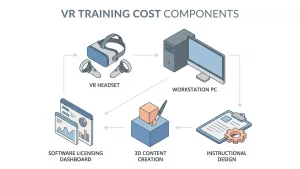
The cost of virtual reality training varies significantly based on your project’s complexity and scope. Most organizations encounter three distinct pricing tiers when exploring VR training solutions.
Entry-Level Implementation: $50,000–$100,000
If you’re new to immersive learning solutions, this tier offers the perfect starting point. Entry-level projects work well for proof-of-concept pilots and straightforward procedural training. You’ll get basic Interactive Training Simulations covering fundamental workplace tasks—ideal for testing the waters before committing to larger deployments.
Standard Enterprise Implementation: $100,000–$200,000
This bracket represents where most serious organizations land when making meaningful commitments to VR training. At this level, you gain access to significantly enhanced customization including:
- Branded virtual environments tailored to your organization
- Replicated tools and equipment specific to your operations
- Multiple training modules covering comprehensive job functions
- Multi-step procedural training with high real-world fidelity
This tier provides the depth needed to address complex training requirements across departments.
Advanced Enterprise Solutions: $200,000+
Organizations investing beyond $200,000 unlock ambitious capabilities that transform training delivery. These enterprise-scale solutions feature multiple virtual environments, advanced haptic feedback systems, AI-driven adaptive learning, and sophisticated performance analytics. Large-scale projects involving digital twins or extensive custom 3D assets can reach $500,000 to $1 million or more, particularly when supporting complex scenarios across global operations.
What You're Actually Paying For: Detailed Cost Components
Understanding the VR training cost requires looking beyond base development. Several additional components significantly impact your total investment.
| Cost Component | Price Range | Notes |
| VR Headsets | $300–$1,500 per unit | Enterprise-grade required |
| Workstation Setup | $1,500–$3,000 each | Includes PC, charging station |
| Software Licensing | $30–$250/user/month | SaaS-based platforms |
| Custom Content Development | $15,000–$60,000 | Depends on 3D complexity |
| 360° Video Production | $15,000–$25,000 | Per video module |
| Instructional Design | $20,000–$40,000 | Per training program |
| Total Hardware (20 users) | $10,000–$50,000 | Complete cohort setup |
Hardware Requirements
VR Training Implementation demands enterprise-grade headsets ranging from $300 to $1,500 per unit. Supporting infrastructure—including high-performance computers and charging stations—adds another $1,500 to $3,000 per workstation. For a typical 20-person training cohort, expect hardware costs between $10,000 and $50,000.
Software and Platform Licensing
SaaS-based platforms typically charge $30 to $250 per user monthly. While this structure supports flexible scaling, cumulative costs can eventually exceed custom development expenses for high-volume deployments.
Content Development and Asset Creation
Custom content creation represents a major cost driver, ranging from $15,000 to $60,000 depending on 3D modeling complexity. Virtual reality services for 360-degree video production add another $15,000 to $25,000 to your budget.
Design and Procedure Development
Professional instructional design services for creating effective training scenarios typically range from $20,000 to $40,000, ensuring your simulations deliver genuine learning outcomes.
Also Recommended: Companies Using VR for Employee Training
The ROI Reality: Why the Benefits of Virtual Reality Training Justify the Investment
| Metric | Traditional Training | VR Training | Improvement |
| Training Speed | Baseline | 4x faster | 300% increase |
| Knowledge Retention | 10% | 75% | 650% increase |
| Cost Per Person (3 years) | $230 | $115 | 50% savings |
| Travel Costs/Employee | $5,000–$15,000/year | $0 | 100% eliminated |
| Training Capacity | Baseline | 5x more learners | 400% increase |
| Workplace Accidents | Baseline | 40% reduction | Major safety gain |
| Typical ROI Timeline | 24-36 months | 12-18 months | 50% faster |
PwC’s research demonstrates that VR learners complete training four times faster while retaining 75% of what they learn—compared to just 10% retention from traditional classroom instruction. Over three years, the cost of virtual reality training drops to approximately $115 per person—nearly 50% below traditional training methods.
Quantifiable savings include:
- Eliminated travel expenses: Save $5,000–$15,000 annually per employee by bringing training in-house
- Increased training throughput: Train five times more employees without adding instructors
- Safety improvements: Reduce workplace accidents by 40%, lowering insurance premiums
- Improved retention: Better-trained employees stay longer, reducing costly turnover
These benefits of Virtual reality training compound over time, making the initial investment increasingly cost-effective.
Strategic Implementation: How to Optimize Your VR Training Investment
Smart organizations don’t jump into full-scale deployments. Starting with pilot programs costing $40,000–$60,000 allows you to validate ROI before scaling. Consider these cost-optimization strategies:
- Develop content modularly to spread costs over time
- Partner with experienced vendors who understand enterprise needs
- Share infrastructure across departments to maximize hardware utilization
- Focus initial deployments on high-risk, high-volume training scenarios
Is VR Training Right for Your Organization?
High-volume, high-risk enterprises see the fastest returns from immersive learning solutions. Manufacturing facilities, healthcare systems, aviation companies, and energy sector organizations—where safety and procedural accuracy are paramount—consistently achieve ROI within the 12-18 month window.
Conclusion
The cost of virtual reality training delivers superior economics for scaled enterprise use. Start with pilot programs around $50,000 to prove the concept, scale to $100,000–$200,000 for core training programs, and invest beyond $200,000 for advanced capabilities that transform your entire learning ecosystem. With proper implementation, you’ll achieve measurable ROI in under 18 months.
If you’re ready to explore how VR can transform your training programs, Juego neXR specializes in creating enterprise-grade immersive learning experiences that deliver measurable business results. Our proven approach ensures you maximize ROI while minimizing implementation risks.
Frequently Asked Questions
Enterprise VR training typically costs $50,000-$200,000+ depending on complexity. Entry-level implementations start around $50,000, while advanced multi-module solutions with custom features exceed $300,000.
Most organizations achieve measurable ROI within 12-18 months through eliminated travel costs, faster training completion, and reduced workplace accidents—with costs dropping 50% compared to traditional methods.
You’ll need enterprise-grade VR headsets ($300-$1,500 each), high-performance computers ($1,500-$3,000 per workstation), and charging stations. A 20-person cohort requires $10,000-$50,000 in hardware investment.
Yes. PwC studies show VR learners complete training 4x faster with 75% knowledge retention compared to just 10% from classroom methods, while reducing workplace accidents by 40%.
Manufacturing, healthcare, aviation, and energy sectors see fastest ROI due to high-risk, high-volume training needs where safety and procedural accuracy are critical for operations and compliance.
Revolutionize the future of business with Juego neXR
Table of Contents
- Understanding Your Investment: Breaking Down VR Training Cost
- What You're Actually Paying For: Detailed Cost Components
- The ROI Reality: Why the Benefits of Virtual Reality Training Justify the Investment
- Strategic Implementation: How to Optimize Your VR Training Investment
- Is VR Training Right for Your Organization?
- Conclusion
- Frequently Asked Questions
Related Posts
Companies Using VR for Training: Leading Brands and Real-World Use Cases
Posted on February 18, 2026

Virtual Reality Future Trends in 2026: How VR Is Evolving Across Industries
Posted on January 20, 2026
Virtual Reality Features and Functions: A Complete Guide
Posted on January 13, 2026




Our Offices

India
Bangalore
GR Grand Plaza, 2nd Floor, JP Nagar, 6th Phase, Bangalore – 560 078



KSA
Jeddah
St Idris Square, 4036 Helmi Koutbi, Al Zahra, Jeddah 23425, Saudi Arabia
Follow Us On:


© 2026 Juego neXR. All Rights Reserved.