Virtual reality has transformed from a futuristic concept into a practical technology that’s reshaping how we learn, work, and play. The global VR and AR market is predicted to reach around 454 million by 2030 with a CAGR of 40.7% between 2020-2030, driven by enterprise training and gaming adoption. But not all VR experiences are created equal. The types of virtual reality vary dramatically in their ability to transport users into digital worlds, and understanding these differences is crucial for anyone looking to harness VR’s potential—especially as fully immersive headsets now command 65% of hardware sales.
When exploring what the different types of virtual reality are, the industry recognizes three primary categories: non-immersive, semi-immersive, and fully immersive. Each serves distinct purposes and comes with its own set of advantages and limitations. The fundamental difference between these types of virtual reality technology lies in how completely they separate users from their physical surroundings and the intensity of sensory engagement they provide.
The Three Main Types of Virtual Reality Systems
The 3 types of virtual reality form a spectrum of immersion.
- Non-immersive VR keeps users fully aware of the real world
- Semi-immersive VR blends physical and digital environments
- Fully immersive VR completely replaces the real world with a virtual one
Understanding these different types of virtual reality helps businesses, educators, and developers invest in the right solution without overspending or underutilizing the technology. Let’s take a deep dive:
Non-Immersive Virtual Reality: Accessible and Practical
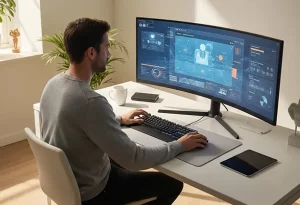
Non-immersive virtual reality, often called desktop VR, represents the most common form of VR technology that people encounter daily. This type allows users to experience computer-generated environments through standard displays—monitors, tablets, or smartphones—while remaining fully aware of their physical surroundings. Think of it as experiencing a virtual world through a window rather than stepping inside it.
The beauty of non-immersive VR systems lies in their simplicity. They rely on everyday computing hardware that most people already own: a personal computer, laptop, gaming console, or mobile device, paired with standard input devices such as keyboards or game controllers. Users interact with virtual environments through these familiar tools, maintaining psychological presence in their physical space while controlling characters or activities in the digital realm.
Common applications include:
- Video games on traditional screens, where players control characters and navigate virtual worlds without isolation from their environment
- Educational software that leverages cost-effective instruction for schools and training programs
- Healthcare rehabilitation programs offering patients accessible, game-based therapy options that reduce cognitive and visual fatigue
- Corporate training modules that don’t require expensive specialized equipment
The advantages of this approach are substantial. Non-immersive VR requires minimal hardware investment and has virtually no learning curve for users already comfortable with traditional gaming or computing. There’s no risk of motion sickness or simulator fatigue, making it ideal for widespread deployment in schools, small businesses, and clinical settings. For organizations exploring the benefits of using VR in training, this type offers the lowest barrier to entry while still delivering meaningful engagement.
Additionally, non-immersive virtual reality simulation can incorporate motion-capture technology through affordable sensors, enabling quantitative movement feedback for rehabilitation without requiring expensive headsets. This makes it particularly valuable for immersive learning solutions that need to scale across large populations without breaking the budget.
Semi-Immersive Virtual Reality: The Middle Ground
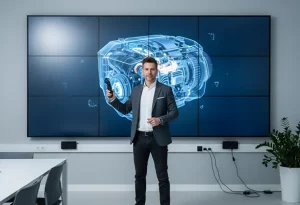
Semi-immersive virtual reality strikes a compelling balance between accessibility and engagement. Among the different types of virtual reality, this category provides users with a partially virtual environment while maintaining awareness of their physical surroundings. It’s a hybrid approach that combines the practicality of non-immersive VR with enhanced visual realism and deeper psychological engagement.
These systems typically rely on large projection screens, multi-monitor setups, or curved display arrays that create a convincing sense of depth and presence without completely isolating the user. The technology achieves realism through high-resolution 3D graphics and spatial depth perception—a principle known as vertical reality depth, where more detailed and layered graphics result in a more psychologically immersive experience.
One prominent example is the CAVE (Cave Automatic Virtual Environment), a room-sized system where projectors direct stereoscopic 3D images onto three to six walls of a cube-shaped space. Users wear 3D glasses and can physically walk around 3D objects, viewing them from different angles while tracking sensors monitor their position and adjust the perspective in real-time. The walls display high-resolution 3D graphics that respond to user movements, creating a remarkably convincing sense of being inside a digital environment.
Key applications of semi-immersive VR:
- Professional pilot training using flight simulators that combine real control panels with virtual window displays
- Automotive design, where engineers walk through life-size 3D models of vehicles before building physical prototypes
- Surgical planning and training that enables visualization of patient-specific anatomy from 3D imaging data
- Virtual laboratory experiments in physics, chemistry, and biology, where expensive or hazardous equipment can be safely simulated
- Architectural walkthroughs allow clients to experience spatial relationships that 2D drawings cannot convey
Semi-immersive VR offers compelling advantages for immersive training in professional contexts. It can accommodate multiple simultaneous users, reducing training costs through group instruction while supporting collaborative decision-making where teams interact with shared virtual models. The technology presents fewer side effects like cybersickness compared to fully immersive VR, making it suitable for extended training sessions. Equipment costs remain reasonable, requiring workstation-grade computers and large display systems rather than expensive individual headsets for each user.
However, this middle ground comes with trade-offs. Users experience reduced depth of presence compared to fully immersive experiences, and physical movement is constrained within the defined space. The sense of embodiment—that feeling of truly being inside the virtual environment—is less pronounced than what fully immersive systems deliver.
Fully Immersive Virtual Reality: The Ultimate Digital Experience
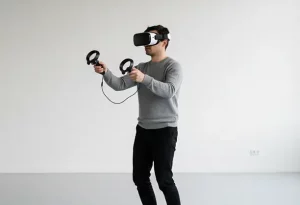
Fully immersive virtual reality represents the pinnacle of VR technology, completely isolating users from their physical environment and delivering the highest level of sensory engagement possible. This is where custom virtual reality solutions truly shine, as these systems aim to stimulate multiple senses—sight, sound, touch, and vestibular perception—creating an extraordinarily convincing illusion that users have left the physical world entirely.
The technology requires sophisticated hardware infrastructure. At its core lies the head-mounted display (HMD), a device worn on the head that provides high-resolution stereoscopic 3D visuals with a wide field of view, typically spanning 100 degrees or more horizontally. HMDs achieve this magic through split-screen technology, displaying slightly different images to each eye to create the stereoscopic 3D effect that our brains naturally interpret as depth—mimicking how our eyes work three inches apart to create binocular vision.
Modern fully immersive systems boast impressive technical specifications. Resolution defines the clarity of displayed content, with current HMDs offering resolutions at or above 2160×1200 pixels split between two lenses. Premium professional-grade headsets like the Varjo Aero deliver even higher resolutions, enabling exceptional visual fidelity for detail-critical applications. Field of view determines how much of the virtual world users can see at once, with consumer headsets typically offering 100-110 degrees and professional models reaching 135 degrees or higher.
Refresh rate matters immensely for comfort. A minimum of 90 frames per second is essential to prevent simulator sickness, with 120+ fps providing noticeably smoother experiences. Higher refresh rates reduce latency between head movements and display updates, maintaining the critical illusion that the virtual world responds instantly to user actions.
Beyond visuals, fully immersive types of virtual reality systems incorporate motion tracking technology using cameras, gyroscopes, infrared sensors, or external tracking systems. These detect the user’s head position and hand movements in real-time, enabling 6DOF (six degrees of freedom)—complete rotational and translational movement through 3D space, just as you’d experience in the real world.
Haptic devices complete the sensory picture. Data gloves, haptic suits, and specialized controllers provide tactile feedback by simulating touch sensations. Spatial audio systems create three-dimensional soundscapes where audio appears to originate from specific directions and distances, perfectly complementing the visual immersion. All of this requires powerful graphics processing with high-performance GPUs capable of rendering complex 3D environments at ultra-high resolutions and frame rates simultaneously for both eyes.
Applications where fully immersive VR excels:
- Entertainment and gaming with titles like Beat Saber and Half-Life: Alyx, placing players inside completely believable virtual worlds
- Military combat training simulations allow soldiers to practice tactical scenarios in risk-free environments
- Surgical simulation enables surgeons to practice complex procedures on realistic patient anatomy before operating on actual patients
- Virtual real estate tours are transporting potential buyers into properties remotely with 360-degree walkthroughs
- Healthcare rehabilitation therapies, including pain management through distraction and mirror therapy for stroke patients
The integration of AI in virtual reality is pushing these applications even further, enabling adaptive training scenarios that respond intelligently to user performance and creating more realistic virtual characters and environments.
Fully immersive VR’s primary advantage is creating a genuine presence—the psychological sensation of actually being in the virtual environment rather than merely observing it. This dramatically enhances learning outcomes, emotional engagement, and training effectiveness. The technology enables safe simulation of dangerous, rare, or expensive real-world scenarios that would be impractical or impossible to practice otherwise, making it invaluable for VR training implementation in high-stakes fields.
The drawbacks are significant, though. The technology commands premium prices, with consumer headsets ranging from $400-$800 and professional systems exceeding $5,000. Fully immersive VR requires considerable physical space for safe movement and can cause motion sickness or fatigue during extended sessions due to conflicts between what the eyes see and what the body’s vestibular system feels. Setup, calibration, and maintenance require technical expertise, limiting accessibility for non-technical users.
Choosing the Right VR Technology for Your Needs
Selecting the appropriate VR technology depends on your specific use cases, budget constraints, and target user populations. Each type of virtual reality system offers distinct advantages that align with different organizational needs and objectives. To help you make an informed decision, we’ve created a comprehensive comparison of the three types of virtual reality technology based on key factors like cost, ideal applications, user capacity, and technical requirements.
| Factor | Non-Immersive VR | Semi-Immersive VR | Fully Immersive VR |
| Best For | Educational programs, rehabilitation therapy, casual gaming, cost-effective training | Professional training, design visualization, collaborative scenarios, group instruction | High-stakes simulation, surgical training, military operations, premium gaming experiences |
| Immersion Level | Minimal – users remain fully aware of physical surroundings | Moderate – partial isolation with enhanced visual realism | Maximum – complete sensory isolation from physical world |
| Cost Range | Low ($0-$500) – uses existing devices | Medium ($5,000-$50,000) – workstation computers and large displays | High ($400-$5,000+ per user) – premium headsets and powerful GPUs |
| User Capacity | Individual users on personal devices | Multiple simultaneous users in shared space | Typically individual users (one headset per person) |
| Learning Curve | Minimal – familiar interface for most users | Low to Moderate – requires some orientation | Moderate – users need time to adapt to immersive environment |
| Motion Sickness Risk | None – no sensory conflict | Low – minimal vestibular disruption | Moderate to High – potential for simulator sickness |
| Physical Space Required | Minimal – desk or couch space | Large – dedicated room or training area | Moderate to Large – safe movement area needed |
| Setup Complexity | Simple – plug and play | Moderate – requires installation and calibration | Moderate to Complex – technical setup and maintenance |
| Ideal Applications | Classroom learning, physical therapy, basic skills training, widespread deployment | Flight simulation, architectural walkthroughs, engineering design, team training | Combat simulation, surgical practice, realistic scenario training, premium entertainment |
| Accessibility | Highest – works on standard devices everyone owns | Medium – requires dedicated facilities | Lower – requires individual expensive equipment |
| Session Duration | Extended – no fatigue concerns | Extended – comfortable for long sessions | Limited – 30-60 minutes typical due to potential fatigue |
Understanding Immersion: The Core Differentiator
The concept of immersion—the degree to which a VR system can isolate users from their physical environment while engaging their senses—fundamentally distinguishes these 3 types of virtual reality. Rather than rigid categories, immersion exists on a spectrum. Non-immersive VR provides minimal sensory isolation while maintaining strong awareness of physical surroundings. Semi-immersive VR partially isolates users through large screens and 3D projection, creating a sense of psychological presence without complete sensory blocking. Fully immersive VR achieves near-total sensory isolation through HMD technology, essentially fooling the user’s brain into believing they inhabit an entirely different reality.
Understanding these differences in types of virtual reality systems empowers organizations to make informed technology investments aligned with their specific objectives, user populations, and resource constraints. Whether you’re exploring immersive learning solutions for corporate training, considering custom virtual reality solutions for specialized applications, or simply trying to understand the different types of virtual reality available today, this knowledge ensures the successful implementation of VR solutions that deliver measurable value and meaningful experiences.
Conclusion
As virtual reality continues to evolve and reshape industries from healthcare to education, entertainment to enterprise training, understanding the different types of virtual reality technology becomes increasingly critical for making smart investment decisions.
Whether you need the accessibility of non-immersive VR, the balanced approach of semi-immersive systems, or the complete sensory engagement of fully immersive experiences, the right VR solution can transform how your organization trains, designs, and innovates. Juego neXR stands as the ideal partner in this journey, offering custom virtual reality solutions tailored to your specific needs across all types of VR systems.
With deep expertise in immersive training, virtual reality simulation, and AI-enhanced VR experiences, Juego neXR delivers end-to-end VR training implementation while ensuring seamless integration with your existing workflows.
Frequently Asked Questions
The three main types are non-immersive VR (desktop-based experiences), semi-immersive VR (partial immersion with large screens), and fully immersive VR (complete sensory isolation using headsets).
Immersive VR uses headsets to completely isolate users from their physical environment, while non-immersive VR displays virtual content on standard screens without sensory isolation.
It depends on your training needs. Fully immersive VR suits high-stakes scenarios, semi-immersive VR works for collaborative training, and non-immersive VR offers cost-effective accessibility.
Consumer VR headsets range from $400-$800, while professional-grade systems can exceed $5,000. Additional costs include powerful computers and software licenses for specialized applications.
Yes, fully immersive VR can cause motion sickness or simulator sickness due to conflicts between visual input and vestibular sensations. Proper refresh rates minimize this risk.
Revolutionize the future of business with Juego neXR
Related Posts
Companies Using VR for Training: Leading Brands and Real-World Use Cases
Posted on February 18, 2026

Virtual Reality Future Trends in 2026: How VR Is Evolving Across Industries
Posted on January 20, 2026
Virtual Reality Features and Functions: A Complete Guide
Posted on January 13, 2026




Our Offices

India
Bangalore
GR Grand Plaza, 2nd Floor, JP Nagar, 6th Phase, Bangalore – 560 078



KSA
Jeddah
St Idris Square, 4036 Helmi Koutbi, Al Zahra, Jeddah 23425, Saudi Arabia
Follow Us On:


© 2026 Juego neXR. All Rights Reserved.